You Don't Need a Science Degree to Ferment Like a Pro
Mastery in Fermentation Is Learned, Not Granted
The myth that keeps great producers from ever starting
There is a belief that I hear again and again through the wine and cider world, among producers and other members of the community, embedded in the way the industry talks about itself:
"Some people have it. Some people don't."
The idea that great fermenters are born, not made. That a refined palate is innate. That intuition in the cellar is a gift; rare, mysterious, and largely non-transferable.
After nearly a decade of training producers across North America and abroad, I had to dismantle that belief with every producer I worked with.
What "natural talent" actually looks like
When we see a winemaker move through a cellar with calm authority, tasting at the right moment, adjusting with precision, anticipating problems before they surface, we tend to call it intuition.
But watch more closely, and what you actually see is: Trained observation, practiced interpretation and a decision framework built through repetition.
What looks like intuition is trained perception.
The experienced fermenter isn't receiving some mystical signal. They have simply made thousands of small observations, connected them to outcomes, and built a reliable internal library.
That library? It can be built and learned intentionally, far faster than it would accumulate through experience alone.
The people I've trained
The producers I've had the privilege of training came from every professional background imaginable. Real estate. Radio communications. Pastry kitchens. Farming. Social work. International trades. Army. Construction,...
None had formal oenology training when we began. Here is instead what they shared:
Genuine curiosity about what was happening in the vessel
Willingness to observe before acting
Humility to follow a system before trusting their gut
Commitment to showing up consistently, even through challenges
Today, several of them lead productions exceeding 300,000 liters annually.
Others have built small, high-margin operations selling directly from the farm, with near-perfect product consistency and a distinct identity.
All of them win awards. Not occasionally. Regularly.
The transformation I witness is not sudden; it is a gradual expansion.
First, they become functional and are able to manage a fermentation safely and confidently.
Then, they become fluent and are able to reading signals others miss, making proactive decisions.
Finally, they become creative, because real creativity in fermentation requires deep understanding. You can't express terroir you don't understand.
My own story
I want to be honest: I was not born knowing how to do this either.
I studied cell biology. I trained as a sommelier. I completed a viticulture and oenology program in France.
And then I was hired as head cidermaker at a production facility pressing and packaging 20,000 liters per week. With one assistant. The outgoing cidermaker left after one week.
Let's say the least that I was nauseous walking in alone that first morning.
For that first year, I was largely following protocols without fully understanding why. Making decisions based on what the recipe said, not on what the fermentation was communicating. Slowly, through crisis and repetition, I developed my own technique. I started improving the product. I began exporting, managing outsourced fermentation and packaging for other companies. But it was harder, and slower, than it needed to be.
I created my training programs because I wished, desperately, that someone had taught me to read fermentation. Not just to execute it.
The palate is trainable. Here's the proof.
One of the most common barriers I encounter is the belief that tasting ability is fixed, that some people simply have a more sophisticated palate. Here is what the science actually shows: the human olfactory system is extraordinarily plastic. It adapts. It learns. It builds neural pathways through exposure and repetition.
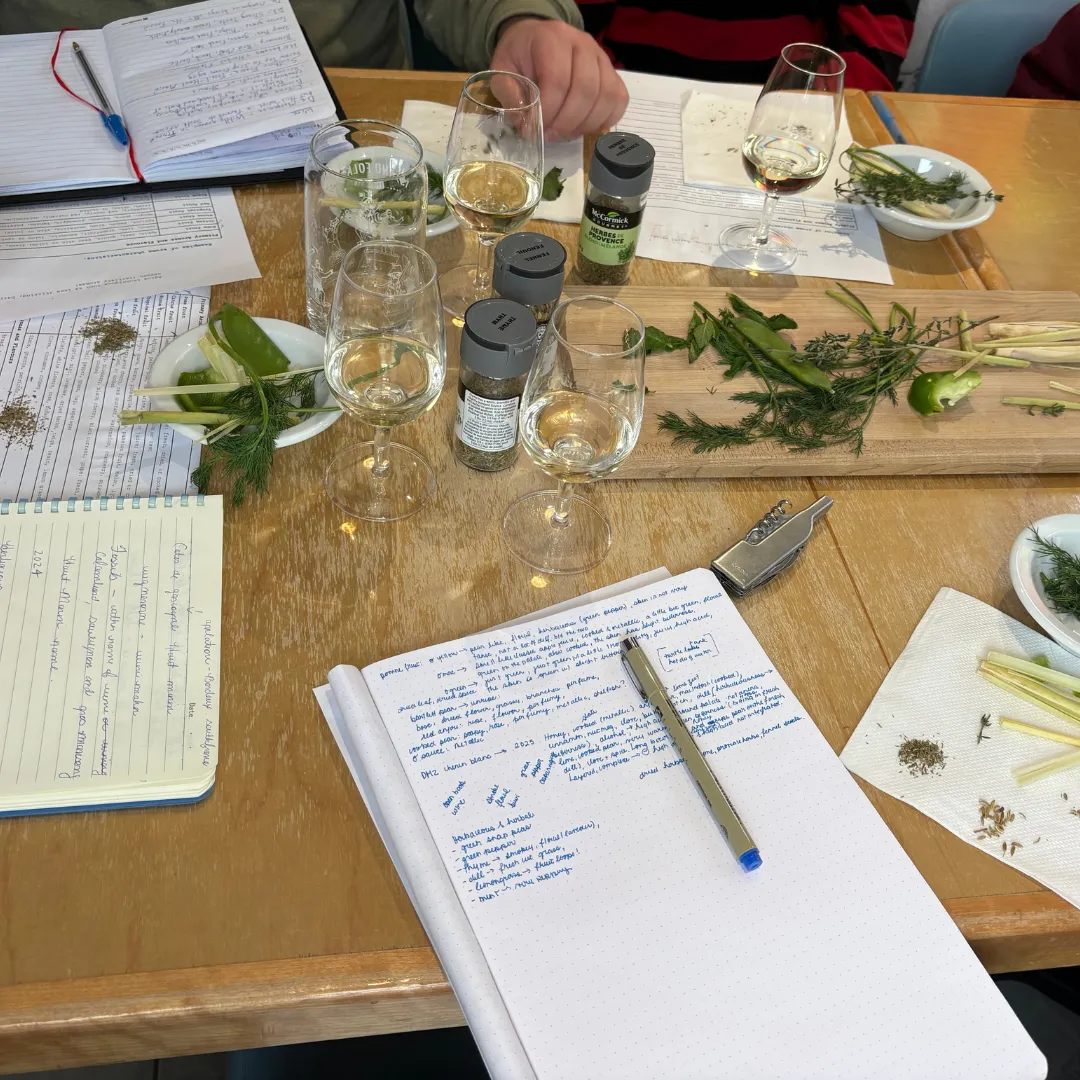
When I teach sensory training, I start with fresh ingredients, real fruit, fresh herbs, spices, jams. I ask producers to smell them in silence, taste them, hold them in memory.
Then I show them the molecules. The actual chemical compounds present in both the fresh ingredient and the wine. As well as cross-referencing the same molecules across multiple ingredients.
Then we find those same aromas in the glass.
Every single time, something shifts. For ALL of them.
We then talk about how important it is to know our own tresholds, our ''innate'' calibration. Because we're not discovering a gift. We're building a pathway.
And pathways, unlike gifts, can be built by anyone.
The hiring myth (and what it costs)
There is a related misbelief I encounter among founders and owners:
"I need to hire someone who already knows fermentation."
I understand the instinct. You're building something serious. You want expertise. But what I've seen, again and again, is that the best hire is often not the most credentialed one. It's the person who is deeply curious, organized, physically committed to the work, local and trainable.
When a founder understands fermentation themselves, they hire differently. Better. They know what questions to ask. What to look for. What attributes predict success in the cellar far better than a diploma.
A founder who is fermentation-literate doesn't need to hire expertise. They build it; in their team, and in themselves.
What Fermentation Intelligence actually is
Fermentation Intelligence is not mystical. It is not reserved for scientists or sommeliers or people with decades of experience.
It is the trained ability to:
Observe what fermentation is communicating in real time
Interpret those signals with accuracy and calm
Make decisions at the right moment; proactively, not reactively
Build toward the product you envisioned, not what randomness delivers
It is a skill. A learnable, teachable, systematizable skill.
And it is available to anyone willing to build it.
If you've been carrying the belief that fermentation mastery isn't for you, I hope this begins to dismantle it. Because the question was never whether you have the gift. The question is whether you have the right framework to develop the skill.
More on that very soon.
What Happens Next&
If this resonates, I'd genuinely love to hear where you're at in your project. You can send me an email ([email protected]) or send me a DM on Instagram (@alexandravinumartisan).
Alexandra Beaulieu is an oenologist, winemaker, and fermentation consultant who has helped wineries, cideries, and craft producers across Canada and abroad design, refine, and scale their fermentation projects for over a decade.

