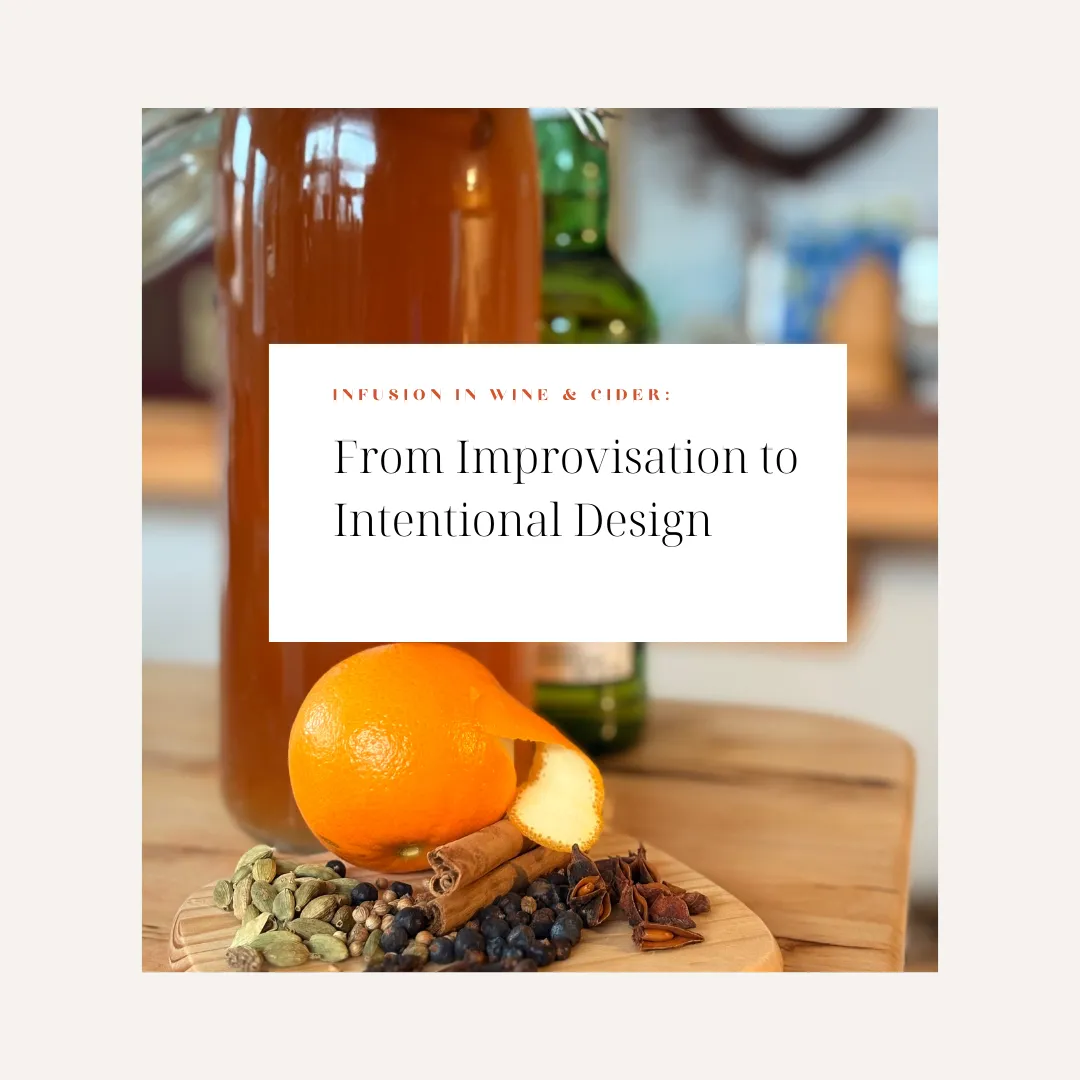
Infusion in Wine & Cider: From Improvisation to Intentional Design
“Infusion isn’t risky because it’s creative.
It’s risky when creativity isn’t held by method.”
Here's something I see and hear regularly:
“Oh… I’ll just infuse that.”
Sometimes it works. But more often, it doesn’t. And when it doesn’t, the loss feels unnecessary, because the batch was already good. Keep reading if you want to learn more.
INTRODUCTION
Infusion is often treated as a casual add-on. A creative flourish. A last-minute idea. But in practice, infusion is neither casual nor random. When done well, it becomes something far more powerful: A deliberate, post-fermentation design tool.
One that can elevate a wine, anchor it in place, amplify its identity, and add a terroir twist that feels unmistakably yours.
This article is here to do two things:
Define what I mean by infusion and when I recommend using it.
Give you a clear, practical method so you can infuse safely and intentionally.
FIRST: LET'S TALK VOCABULARY
Before we talk methods, we need one clear distinction:
Co-fermentation
When you add botanicals, spices, fruits, herbs (or other ingredients) during active fermentation, I consider that co-fermentation.
Even though herbs and spices don’t directly drive alcoholic fermentation (they have very little sugar), they still evolve aromatically within fermentation conditions. The yeast environment transforms aroma compounds. The result can be beautiful… but it’s also a commitment.
The main advantage:
You get those deeper and unique “fermented” aromatic shifts that can’t be replicated later. The level of integration is also superior.
The main disadvantage:
You can’t fully evaluate the outcome before you start. It’s irreversible. Also, beginning of fermentation can be a very hectic moment for you and so thinking space may be limited.
Co-fermentation can absolutely be done with:
Herbs
Spices
Botanicals
And of course, with fruits as well (where sugar and fermentation dynamics are more direct).
I recently dove deep into the co-fermentation choices and methods in my newsletter. If you are interested in learning more (advantages, workflow, when to ferment together vs separately), send me an email ([email protected]) or a DM on Instagram (@alexandravinumartisan) and I will happily forward them to you!
Infusion (As we are using it here)
For the purpose of this post, infusion refers to a post-fermentation step.
This is what makes infusion so interesting.
Because infusion is the part where you can:
Taste first
Decide with intention
Try on small volumes
Adjust
And stop extraction when time is right
Infusion, done properly, is: Control & Creativity.
THE TRUTH ABOUT RISK
Let’s be honest; Infusion is not risk-free.
No method ever is really...
But the risk isn’t the “infusion itself.”
The risk comes from:
Improvisation without method
Lack of understanding
Contamination vectors
Scaling up without trials
So I’ll say it clearly:
A method can reduce risk (greatly!). It does not eliminate it.
That’s true for everything in wine and cidermaking.
MY LINE IN THE SAND: WHAT I DON'T RECOMMEND
I don’t recommend infusing fruits post-fermentation
Fruits contain sugar. Sugar post-fermentation is an invitation to refermentation at a vulnerable stage (especially if the wine/cider was otherwise stable and clean).
It can introduce:
Microbial instability
Unintended volatile shifts
Aroma deviation
If fruit is part of the vision, I recommend:
Planning it earlier through co-fermentation, or
Fermenting the fruit separately and blending later
INFUSION AS A DESIGN TOOL
Here’s an important shift I want you to hold:
Infusion is not decoration.
It’s authorship.
It’s a conversation between:
Your intuition
Your fruit
Your vision for the cuvée
Your terroir
And the final emotional experience you want in the glass
When infusion is treated with intention, it can do something very special:
Amplify depth
Sharpen a style
Create a signature
Fix minor issues
Add a place-based twist that customers remember
THE PRACTICAL METHOD: A CELLAR-READY FRAMEWORK
Below is the framework I use in real production environments (both small and commercial).
Step 1: is infusion appropriate here?
Before thinking about herbs, spices, or botanicals, take a moment to think of the below factors:
Infusion asks something very specific of the base wine or cider.
It assumes that fermentation is finished, and that the product is stable enough to be observed, tasted, and evaluated over time.
This matters because infusion can do two very different things:
It can elevate a wine or it can hide minor flaws.
But it can't: fix major issues such as potent aromatic deviations or microbiological or protein deviations; where it can make things worst in some cases.
So before moving forward, take a moment to reflect.
Ask yourself:
Is fermentation fully complete, or am I still in an active or unstable phase?
Is the wine or cider stable enough to run trials without it changing underneath me?
Do I have a clear intention for this infusion, or am I reacting to a perceived gap or discomfort in the wine?
Infusion works best when:
The base wine or cider is already sound and expressive on its own
You are shaping identity, adding nuance, or amplifying a direction
Not trying to correct structural issues that belong elsewhere in the process
And you have a clear plan for containment, monitoring, and removal
Step 2: Choose the infusion material ➺ Fresh vs Dried matters
Fresh herbs and botanicals
When fresh, consider your infusion material as delicate and expressive.
But fresh also carries a microbial load and can't be boiled; Boiling fresh herbs can dramatically alter aromatic expression.
Think of mint or parsley. Boil them and the aromatic signature changes completely. You might still like the result, but it will be different than a fresh infusion.
Best practice approach:
Direct infusion (no boiling)
Manage exposure to oxygen
Contain properly
Taste frequently
If you want to reduce microbial load without denaturing aromatics, a brief dip in an acidified sulfite solution (KMS + citric) can help reduce surface populations. It’s not sterilization, but it’s a risk reduction step.
Dried botanicals and spices
Dried spices are often carriers of molds.
In this case, boiling is often appropriate because:
It reduces microbial risk
And generally does not “damage” the aromatic contribution the same way it would for fresh leafy herbs
Especially if you’re not sterile filtering, this matters. You can then decide to add the spice itself, the ''tea'' that was creating during the boiling phrase or both. Trials, as described below will help you figure this step out.
Step 3: Containment is non-negotiable
This one is simple and strict:
Use a mesh bag / infusion basket / contained system.
Why:
Easier removal
Easier racking
Less solids in tank
Cleaner product (esthetically and sensorily)
Easier filtration/clarification
Dramatically reduces surface-floating risks
Also: it allows you to easily control contact time and minimize oxygen:
Step 4: Avoid the surface at all costs
This is one of the biggest mistakes.
Surface contact = oxygen + opportunity for aerobic microorganisms and mold.
Mold risk climbs fast. And once mold aromas are present, you can’t “un-smell” them.
If you don't plan on filtering the consequences associated with the presence of mold can be even greater.
Anything that stays floating can dry and attract mold and other aerobic microorganisms.
Make the infusion material:
Fully submerged, or
Weighted down inside a mesh bag
If needed:
Punch down gently (once or twice daily)
Use a clean weight system
Avoid open headspace and oxygen exposure
This one step prevents a lot of heartbreak.
Step 5: Start small; Try before you commit
This is where “intentional design” becomes real.
Pull one or several small, full vessels:
1 L
5 L
23 L
(or any volume that makes sense, as long as the vessel is full and protected)
Then design trials where you control the variables:
What to test
At minimum, test:
Ratio (quantity of material per liter)
Time (how long it sits)
If you want to go further, test:
Temperature of extraction (cold vs cellar temp vs warmer conditions)
The key rule
Try to change one variable at a time between your different trials.
If you test multiple, time and dose simultaneously for example, you’ll learn less.
Step 6: Taste early, taste often, and write things down
Infusion extraction can accelerate quickly.
An extraction that seems subtle at 6 hours can become dominant at 24.
A botanical that feels perfect at day 2 can become bitter at day 5.
❊ Think of when infusing tea how minutes & temperature affects the results.
Taste on a schedule that matches intensity:
Dried spices tend to infuse father than fresh botanicals
I recommend daily testing
And yes: take notes. Most of you will have heard me citing the below quote, but here it is again:
"What is measured improves.
What is measured and recorded improves exponentially.''
Step 7: It's time to scale up with confidence
Once you have a trial you love, you can extrapolate to the full tank.
This is a good moment to also take into consideration your own cellar reality:
Tank geometry
Mixing & punching down ability
Time constraints
Racking schedule
Filtration/Clarification plan
In client work, additional factors we also consider:
How to implement without chaos (choose an appropriate production window so the creativity and note taking is not compressed by too many other urgent tasks)
How to remove material cleanly (think ahead of time)
How to avoid oxygen pickup during and after the infusion
How to keep it repeatable year to year (independent of volume. Or in other word: Scalable)
EXAMPLES (FOR INSPIRATION AND POSSIBILITY)
Some infusions I love (and that can be extraordinary when designed well):
Wild blueberry wine + baking spices (think Gluwein base, but precise and elegant)
Lavender honey mead amplified with a lavender infusion (layering instead of overpowering)
Hybrid rosé infused with rose petals (when done well, it’s quietly unforgettable)
Wild apple cider infused with fir, spruce, or pine needles (a true northern signature. Unbelievable pairing with boreal cuisine)
And yes; Creativity belongs here.
Just let method hold it.
BEFORE YOU INFUSE: 3 QUESTIONS
What is/are my intention(s)?
(Amplify? Add tension? Add lift? Add depth? Structure? Acidity? Mid-Palate? Create a terroir signature?)How will I control extraction?
(Trials, tasting schedule, containment, removal plan)What is my exit strategy?
(If it goes too far, do I have blending options?)
WANT TO GO DEEPER?
If you’re planning an infusion and want to think it through properly, I’d love to hear from you.
Send me an email (alexandra@abmicroproduction) or a DM on Instagram (@alexandravinumartisan)
What you’re infusing
What base you’re working with
What you want it to express
And what your biggest challenge is
Want to work together? If you're dreaming of launching your own wine or cider project or bringing more clarity to the one you already have, I'm here to help.
A no-commitment 15-minute session designed to:
Review your current production reality or project direction
Identify key challenges
Clarify your most aligned next step
Determine whether deeper support would be helpful at this stage
I am truly looking forward hearing about your project!
Alexandra
QUICK NOTE
This article is educational and meant to support decision-making. Every cellar, product, and regulatory context is different. Always adapt to your reality, your risk tolerance, and your stability goals.

