Fermentation has its own seasons. Expansion vs Contraction.
Fermentation has its own seasons.
Do you know which one you are in?
Step outside right now and pay attention.
The bees are frantic in the best possible way, moving between flowers with an urgent generosity, collecting and depositing, feeding a colony that is expanding into itself.
The apple trees are heavy with blossom, a few weeks away from setting fruit that will spend the next four months becoming something worth waiting for.
The light lingers longer everyday. Even the soil feels different underfoot, warmer, more alive, more willing. Everything is moving outward, opening, reaching.
We are in it. Full, unambiguous expansion.
And if you are a winemaker or a cidermaker, you know that the season outside your door is telling you something important about what is happening inside your tanks.
The rhythm no one teaches you
When I started working with fermentation seriously, I was taught to manage it. Temperature control, nutrient additions, punch-downs on schedule, racking at specific gravity targets. All of it framed as a process to be directed, timed, optimized.
What I was not taught, and what took me years to understand, is that fermentation has a seasonal intelligence of its own. It expands, it contracts, it releases. And the makers who produce the most coherent, alive, interesting wines and ciders are not always the most technically precise. They are the ones who learned to recognize which phase they are in and respond accordingly, rather than imposing a predetermined plan on a living process.
This is not mysticism. It is biology. And once you see it, you cannot unsee it.
What expansion actually looks like
Expansion is the phase we love most because it is the most visible. Primary fermentation is pure biological exuberance: yeasts consuming sugars at a rate that produces heat, CO₂, movement. The cap rises. Temperatures climb. The must is alive in a way you can see, smell, and feel even through the tank wall.
But expansion is not only primary fermentation. I believe that it extends further.
A wine in the months following its primary fermentations is still expanding in a subtler sense. Flavour compounds are still developing. Yeast cells are still contributing complexity through autolysis. The wine is still becoming. It is still reaching outward into what it will eventually be.
This is the phase that asks the most patience from you. You are witnessing something build. Your job is to provide the conditions for that building and to resist the urge to rush it toward the next stage before it has arrived there on its own.
The question to ask yourself during expansion: is this ferment still becoming, or is it done becoming and simply waiting for me to recognize it?
What contraction actually looks like
Contraction is the phase we resist most, in our life in general, and I think it is because we were never taught to trust it.
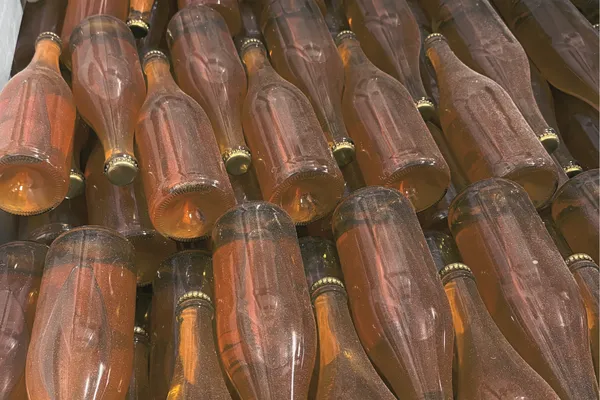
The act of bottling is the contraction in its purest form. It is interior work.
The wine in contraction is integrating. Tannins are polymerizing and softening. Acids are finding their balance. Phenolic compounds are binding and settling. The wine is doing something that cannot be hurried, a kind of molecular patience that produces the structural coherence that separates a merely fermented liquid from something genuinely compelling to drink.
Winter does this too. The vineyard in January looks dormant, maybe even dead to an unfamiliar eye. But underground the vine is storing reserves, resting, building the architecture for the next season's growth. The contraction is not a failure of expansion. It is the biological requirement for the next one.
What contraction asks of you is harder than what expansion asks. It asks you to trust that nothing visible happening is not the same as nothing happening. It asks you to witness without intervening.
The question to ask yourself during contraction: is the wine ready for its next, ultimate expansion phase or does it need more time?
The threshold between them
Right now, in early June, my own wines are living at a particular place on this arc that I find almost unbearably interesting.
They are at the very edge of their expansive season. Not contracting yet, but tilting toward it. They have found most of their shape, although there are still hints of expansive activity. The contraction of bottling is coming and the wine knows it before I do.
There is something I have come to regard as sacred about that threshold moment. The fullest expression of a thing, right before it turns. It is where I try to do my most careful tasting, my most honest assessment, the last of the blending. Not because I want to make changes but because I want to truly witness what this wine has become before I seal it away.
The release: what happens after contraction
The bottle is not the end. It precedes the last of the wine's expansion; an integration under pressure, a long dark patience. Reductive chemistry slowly shifts. Bottle shock settles. The wine slowly becomes something different.
And then one day someone opens it.
Everything those molecules have been through arrives in a glass and becomes simply: A moment. Pleasure. Memory. Someone laughing, crying, or reaching across the table.
I get shivers thinking about the distance those molecules will have travelled. From flower to fruit to juice to ferment to cellar to bottle to table to a moment someone carries without knowing where it came from. That arc is not small. You, the maker, walked with it through every phase of it.
Which means your role was never only technical. It was to be present enough to recognize which season your wine was in, and to meet it there rather than dragging it somewhere it was not yet ready to go.
How to actually use this
This is not a framework for passive winemaking. Knowing which phase your ferment is in does not mean doing nothing. It means doing the right thing at the right time, which is a fundamentally different orientation than doing the scheduled thing at the scheduled time.
During expansion: taste often, observe closely, support the conditions. Your job is to sustain the environment for becoming.
At the threshold: taste with full attention. Not to critique but to witness. Take notes you will actually read so that you remember. This is the moment of maximum information about what you made and what it needs before it goes into the bottle.
At bottling and beyond: handle gently, rest the wine after bottling, resist opening too early. Your job is to hold the space for integration.
The question to ask throughout the process: What phase is this wine actually in, right now, today? Not what phase your timeline says it should be in.
The question worth sitting with
There is a larger principle underneath all of this that I keep returning to in my work with producers across Canada and internationally.
The makers who struggle most are often the ones imposing their calendar on a biological process that has its own seasons.
That being said, I also want to acknowledge the cashflow pressure and the reality that following the wine's preferred rhythm is not always possible. Know that there are ways in which you can structure the wine throughout the process so that it becomes what it needs to within the required business structure; just like a river offers a bank to the water so that it can keep flowing together.
Maybe you are curious as to what those supporting and structural steps would look like in your practice? That is exactly what we work through together.
Alexandra Beaulieu is a consulting oenologist and fermentation educator working with boutique wineries, cideries, and meaderies across Canada and internationally. She is the founder of the Fermentation Fundamentals, a professional training program for small-scale producers built around sensory-led, upstream decision-making.
What Happens Next
If this resonates, I'd genuinely love to hear where you're at in your project. You can send me an email ([email protected]) or send me a DM on Instagram (@alexandravinumartisan).

